One of my earliest memories of having, what you might call, a more adult conversation with my father was on a sunny late morning walking along the Victoria Embankment. It would have been the mid 60s and I don’t have a clue where we had been and I can’t even guess why we were walking along the north side of the river between Blackfriars and Westminster when we lived in Peckham but I clearly remember we were and that it was a warm, sunny, halcyon day. There are some interesting, (well at least I think so), stories to tell based around this area not the least of which is that the place I was walking on that sunny morning so many years ago is a man made construction completed in 1870 to carry both  the underground, and the sewers to
clean the river; however I don’t intend to go into that story as we could fill the magazine with it. Suffice to say that if you go into Embankment Gardens beside Villiers Street to can see where the riverside once was from the position of the river gate entrance of the Duke of Buckingham. In doing this 37 acres of new land was reclaimed from the River.
Oddly however there is a much older construction on the “new” riverside than Buckingham's Gate, in fact it is the oldest man-made construction in London. From further back in history, even than the woman for who it is named, Cleopatra’s Needle was originally built and stood in Egypt, around 1500BC. (If you remember Cleopatra was a consult to Julius Caesar who landed in Kent in a mere 55bc).
It was erected on the Victoria Embankment in 1878 following a long sea voyage and the loss of a crew which had been bringing it to London as a “gift” to the British people in recognition of Nelson’s victory over the French fleet, at the Battle of the Nile in 1798. It is made of granite and the obelisk is 68 feet high and 180 tons in weight.
 A couple of odd facts about the pink-granite monolith that it stands on a pedestal, supposedly guarded by two sphinxes, I say supposedly ‘cos the Victorian designers got it wrong, in order to guard the Needle they should face out; instead they face in towards it. Under the Needle buried in the pedestal are two earthenware pots, containing various objects. This very early version of a time capsule holds a portrait of Queen Victoria, iron ropes and cables, a hydraulic jack, copies of an engineering magazine, and portraits of 12 of the most beautiful Englishwomen of the time!
 Just as Cleopatra’s Needle forms a centrepiece between Waterloo and Hungerford Bridges, (where because of it’s presence the embankment has been given an Egyptian theme with the benches made with sphinxes and camels for arms), another monument also stands on the embankment forming the centrepiece between Hungerford and Westminster.
Completed in 1923 the Royal Air Force Memorial is a simple monument in Portland stone surmounted by a gilded eagle. The original intention was for the eagle to  face inwards to the embankment but the design was altered at the last moment so the eagle faced across the river, symbolically to France. The position was not the first choice, discarding a proposal to join the Army and the Navy in building a memorial opposite Buckingham Palace, the Royal Air Force Memorial Fund had hoped to raise a Cross on the ground between Westminster Abbey and St Margaret’s Church; a hope that the Dean of Westminster was unable to approve because he preferred not to consider a memorial for the Royal Air Force alone. So offered a site at the head of the Whitehall Stairs, that’s where the memorial went.
Currently a new monument is being built, the Battle of Britain Monument which is being sited on an existing panelled granite structure 25 metres long. This structure was originally designed as a smoke outlet for underground trains when they were powered by steam engines. It has been filled up and blocked for many years.
A walkway will be cut obliquely through the middle of the structure, and bronze reliefs, depicting aspects of the Battle in the air and the back-up on the ground, will be placed along either side.
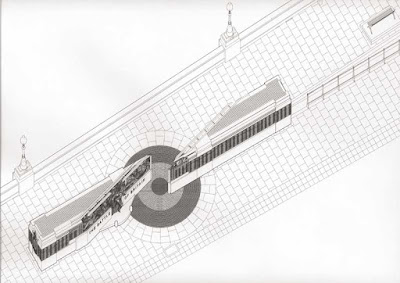 I feel this is quite appropriate as both the RAF Memorial and Cleopatra’s Needle were damaged by enemy bombs in the last war, which I remember my father showing me – along with the remains of a pavement artist’s work which had been abandoned there from the day before.
Whenever I walk down the embankment today, especially in the sun, I think of him – not much has changed there since that day. I only wish I knew why we were there – and where we’d been.
Laurie Smith


